


Put the math expression within $…$:
\(\LaTeX{}\)
$\Pi$
$ a * b = c ^ b $
$ 2^{\frac{n-1}{3}} $
$ \int_a^b f(x)\,dx. $
\( \int_a^b f(x)\,dx. \)
| $ \rho {\rm{FOD}} = \sum\limits{\sigma ,i} {(\delta _1 - \delta _2 n_i^\sigma ) | \phi _i^\sigma ({\bf{r}}) | ^2} $ |
| $$ \rho {\rm{FOD}} = \sum\limits{\sigma ,i} {(\delta _1 - \delta _2 n_i^\sigma ) | \phi _i^\sigma ({\bf{r}}) | ^2} $$ |
Here is a liquid filter.
`escape inline code`
inline code
Here is a capture block.
100 / 3 = 33


1. 21312
2. 21312
4. 4214
>
1
2
3
4
5
6
7
8
9
10
11
12
13
14
15
16
17
18
19
20
21
22
23
24
25
26
27
28
29
30
31
32
33
34
35
36
37
38
import networkx as nx
from collections import Counter
diagrams = defaultdict(list)
particle_counts = defaultdict(Counter)
for (a, b), neighbors in common_neighbors.items():
# Build up the graph of connections between the
# common neighbors of a and b.
g = nx.Graph()
for i in neighbors:
for j in set(nl.point_indices[
nl.query_point_indices == i]).intersection(neighbors):
g.add_edge(i, j)
# Define the identifiers for a CNA diagram:
# The first integer is 1 if the particles are bonded, otherwise 2
# The second integer is the number of shared neighbors
# The third integer is the number of bonds among shared neighbors
# The fourth integer is an index, just to ensure uniqueness of diagrams
diagram_type = 2-int(b in nl.point_indices[nl.query_point_indices == a])
key = (diagram_type, len(neighbors), g.number_of_edges())
# If we've seen any neighborhood graphs with this signature,
# we explicitly check if the two graphs are identical to
# determine whether to save this one. Otherwise, we add
# the new graph immediately.
if key in diagrams:
isomorphs = [nx.is_isomorphic(g, h) for h in diagrams[key]]
if any(isomorphs):
idx = isomorphs.index(True)
else:
diagrams[key].append(g)
idx = diagrams[key].index(g)
else:
diagrams[key].append(g)
idx = diagrams[key].index(g)
cna_signature = key + (idx,)
particle_counts[a].update([cna_signature])
:
: :
: $$O_3 + C_2H_2 \rightarrow $$ :||
: $$O_3 + C_2H_4 \rightarrow $$ :||
: :
: ^^ Method :
^^ $$\lambda^a$$
vdW
TS
cycloadd.
vdW
TS
cycloadd.
^^ MAE
$$\lambda$$-tPBE
0.20
-0.40
7.69
-68.00
-1.86
4.87
-57.57
1.29
MC1H-PBE $$^b$$
0.25
-1.08
3.66
-70.97
-1.25
0.13
-61.26
3.35
Reference values $$^c$$
———
-1.90
7.74
-63.80
-1.94
3.37
-57.15
———
$$^a$$ The optimal mixing parameter.$$~$$ $$^b$$ From Ref. .$$~$$ $$^c$$ Best estimates from Ref. . |||||||
1
2
3
4
5
6
7
spancell1 |
spancell2 |
cell
spancell3 |
^^ spancell1 |
spancell2 |
cell
spancell3 |
(0,0)
(0,1)
(0,2)
(0,3)
(1,0) |
^^
(1,3)
(0,0)
(0,1)
(0,2)
(0,3)
(1,0) ||
(1,3) |
(0,0)
(0,1)
(0,2)
(0,3)
(1,0) ||
^^
(0,0)
(0,1)
(0,2)
(0,3)
\
(1,0) ||
^^
Table
Stage
Direct Products
ATP Yields
Glycolysis
2 ATP |
^^
2 NADH
3–5 ATP
Pyruvaye oxidation
2 NADH
5 ATP
Citric acid cycle
2 ATP |
^^
6 NADH
15 ATP
^^
2 FADH
3 ATP
30–32 ATP ||
: Here’s a Inline Attribute Lists example :|||
: :
: <div style="color: red;"> < Normal HTML Block > </div> :||
^^
Red {: .cls style="background: orange" } ||
^^ IALs
Green {: #id style="background: green; color: white" } ||
^^
Blue {: style="background: blue; color: white" } ||
^^
Black {: color-style font-style} ||
Heading
Column 1
Column 2
Row 1
Apple1(Footnote)
Orange
Row 2 (merged)
Blueberry
Strawberry
^^
[Plum](https://example.com)
Raspberry 
Not in table: <Mail Gateway>
In table:
Decision Point
Design Decision
Authoritative DNS MX Record
<Mail Gateway>
9 * 9
1 * 1 = 1
1 * 2 = 2
2 * 2 = 4
1 * 3 = 3
2 * 3 = 6
3 * 3 = 9
1 * 3 = 3
2 * 3 = 6
3 * 4 = 12
4 * 4 = 16
Emoji
Mathjax
$\LaTeX{}$
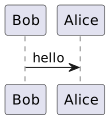
PlantUML
Video

Special media links

Tips:
- Use pipes (
|) to delineate columns, and dashes to delineate the header row from the rest of the table.
- Spacing doesn’t matter to the markdown processor, any extra white space is removed, but it can really help with readability. The two markdown examples below both create this table.
Use pipes (
) to delineate columns, and dashes to delineate the header row from the rest of the table.
Footnote ↩